Demilitarized South China Sea BY DESTROYING ALL CHINESE ISLANDS INSIDE THEIR NINE DASH LINE
South
China Sea dispute: China's pursuit of resources 'unlawful', says UNCLOS
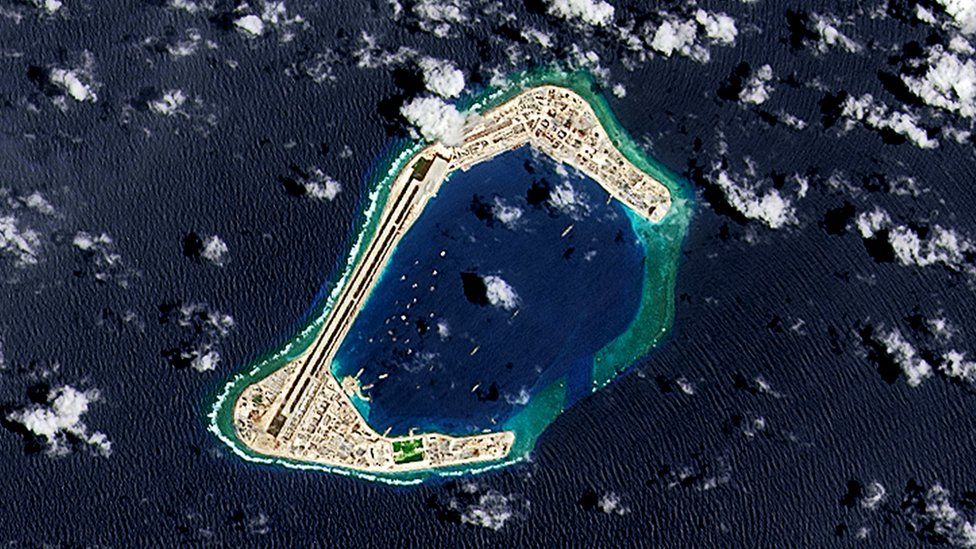 IMAGE SOURCE,GETTY IMAGESImage caption,The US has previously accused China of militarising the South China Sea (file photo)
China's pursuit of offshore resources in parts of the South China Sea is "completely unlawful", US Secretary of State Mike Pompeo has said.
He condemned Beijing's "campaign of bullying to control" disputed waters that are potentially energy-rich.
China, which has been building military bases on artificial islands in the area for years, said the US "deliberately distorts facts and international law".
The US has long opposed China's actions but not called them illegal until now.
ADVERTISEMENT
Mr Pompeo's comments come amid worsening relations between China and a number of other countries. It is unclear what new actions, if any, the US might take to back up its stance.
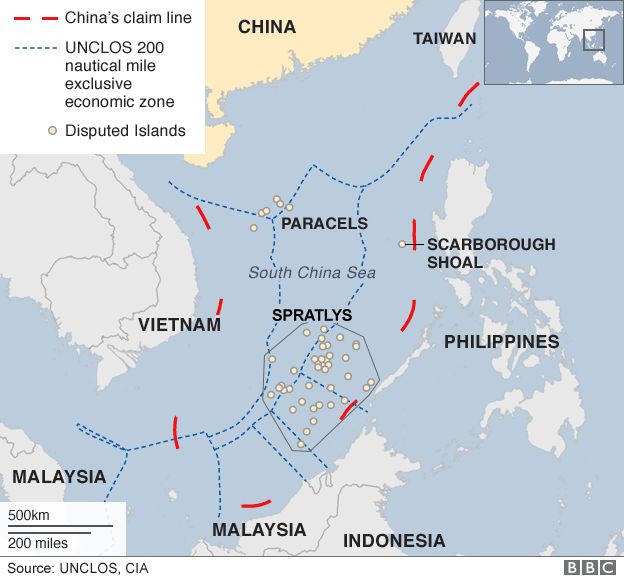
Brunei, Malaysia, the Philippines, Taiwan and Vietnam contest China's claim to almost all of the South China Sea. The countries have wrangled over territory for decades but tension has steadily increased in recent years.
Beijing claims an area known as the "nine-dash line" and has backed its claim with island-building and patrols, expanding its military presence there, although it insists its intentions are peaceful.
Although largely uninhabited, two island chains in the area may have reserves of natural resources around them. The sea is also a shipping route and has major fishing grounds.
In its annual defence review, Japan said China's naval activities were a matter of grave concern, accusing Beijing of trying to alter the status quo in the East and South China Seas.
What did Mr Pompeo say?
In a statement on Monday, Mr Pompeo denounced China's claims on the disputed Spratly Islands in the South China Sea, saying Beijing had "no legal grounds to unilaterally impose its will on the region".
He said the US, which has previously said it does not take sides in territorial disputes, rejected Beijing's claims to waters off Vietnam, Malaysia and Indonesia.
"Any [People's Republic of China] action to harass other states' fishing or hydrocarbon development in these waters - or to carry out such activities unilaterally - is unlawful," he said.
"The world will not allow Beijing to treat the South China Sea as its maritime empire."
How did China respond?
In a statement posted on Twitter, the Chinese embassy in Washington DC said the US state department "deliberately distorts the facts and international law including the United Nations Convention on the Law of the Sea".
It said America "exaggerates the situation in the region and attempts to sow discord between China and other littoral countries.
"The accusation is completely unjustified. The Chinese side is firmly opposed to it."

Significant risks with seemingly insignificant islands
Zhaoyin Feng, BBC Chinese, Washington DC
Before now, the US had not taken sides on territorial disputes in the South China Sea.
Four years after an international tribunal in The Hague ruled that China's claims in the region had no legal basis, the US has for the first time officially made its stance clear. But why now?
Last week, China and the US held naval exercises in the area at the same time - a rare phenomenon indicating rising tensions.
In the bigger context, the Trump administration has pledged to overturn what it says is 40 years of policy failure with regard to China. Washington has recently criticised Beijing on issues ranging from its handling of the coronavirus pandemic, to human rights violations against Muslim minorities in Xinjiang and how it has dealt with pro-democracy protests in Hong Kong.
But it was China's land reclamation projects in the South China Sea that prompted the rest of the world to reassess Beijing's international ambitions.
And the stakes in the region are incredibly high. In these seemingly insignificant island chains and reefs, there are growing risks of military conflict between the world's two most powerful countries.
Mr Pompeo said the US stood "with our South-East Asian allies and partners in protecting their sovereign rights to offshore resources," adding that this position was "consistent with their rights and obligations under international law".
What's behind the South China Sea dispute?
The sea has in recent years become a flashpoint for tensions between China and other nations which claim sovereignty over two largely uninhabited island chains, the Paracels and the Spratlys.
China claims the largest portion of territory, saying its rights go back centuries.

The US has long been critical of what it says is China's militarisation of the region and routinely angers Beijing with "freedom of navigation" missions.
In August 2018, a BBC team flew over the disputed South China Sea islands in a US military plane. In a radio communication, the pilots were warned to leave the area "immediately" in order to "avoid any misunderstanding".
Media caption,
A BBC team flew over the disputed South China Sea islands in a US military plane in 2018
Months earlier, China landed bombers in the disputed territory to take part in drills on islands and reefs.
China has previously accused the US Navy of provocation and interference in regional matters.
IMAGE SOURCE,China’s sweeping claims of sovereignty over the sea—and the sea’s estimated 11 billion barrels of untapped oil and 190 trillion cubic feet of natural gas—have antagonized competing claimants Brunei, Indonesia, Malaysia, the Philippines, Taiwan, and Vietnam. As early as the 1970s, countries began to claim islands and various zones in the South China Sea, such as the Spratly Islands, which possess rich natural resources and fishing areas.
In recent years, satellite imagery has shown China’s increased efforts to reclaim land in the South China Sea by physically increasing the size of islands or creating new islands altogether. In addition to piling sand onto existing reefs, China has constructed ports, military installations, and airstrips—particularly in the Paracel and Spratly Islands, where it has twenty and seven outposts, respectively. China has militarized Woody Island by deploying fighter jets, cruise missiles, and a radar system.
To protect its political, security, and economic interests in the region, the United States has challenged China’s assertive territorial claims and land reclamation efforts by conducting FONOPs and bolstering support for Southeast Asian partners. Also in response to China’s assertive presence in the disputed territory, Japan has sold military ships and equipment to the Philippines and Vietnam in order to improve their maritime security capacity and to deter Chinese aggression.
Concerns
The United States, which maintains important interests in ensuring freedom of navigation and securing sea lines of communication (SLOCs), has expressed support for an agreement on a binding code of conduct and other confidence-building measures. China’s claims threaten SLOCs, which are important maritime passages that facilitate trade and the movement of naval forces.
The United States has a role in preventing military escalation resulting from the territorial dispute. Washington’s defense treaty with Manila could draw the United States into a potential China-Philippines conflict over the substantial natural gas deposits or lucrative fishing grounds in disputed territory. The failure of Chinese and Southeast Asian leaders to resolve the disputes by diplomatic means could also undermine international laws governing maritime disputes and encourage destabilizing arms buildups.
Recent Developments
Tensions between China and both the Philippines and Vietnam have recently cooled, even as China increased its military activity in the South China Sea by conducting a series of naval maneuvers and exercises in March and April 2018. Meanwhile, China continues to construct military and industrial outposts on artificial islands it has built in disputed waters.
The United States has also stepped up its military activity and naval presence in the region in recent years, including freedom of navigation operations (FONOPs) in January and March 2018. In a speech during his November 2017 visit to Southeast Asia, President Donald J. Trump emphasized the importance of such operations, and of ensuring free and open access to the South China Sea. Since May 2017, the United States has conducted six FONOPs in the region.
Comments