


FLYING  AIRCRAFT CARRIER POWERED BY Turboelectric Distributed Propulsion Engine 

My conceptual design will be without the potruding nose but an upward deck where the planes can be launched in a 30 degree angle at the bow. The wings are fixed and a hybrid Blended Wing Body (BWB).
It will have two twin vertcal stabilizer situated halfway on the wings slanted outward from bow to aft, as the wings will be the whole length of the ship. All engines will be on the other side of the vertcal stabilizer allowing for a clean flight deck and safety for deck personnel.


Wing-mounted engines supply 80 per cent of the thrust required during take-off and 55 per cent at cruise. The tail-mounted all-electric (boundary-layer ingesting) BLI turbofan (pictured) accounts for the remaining thrust
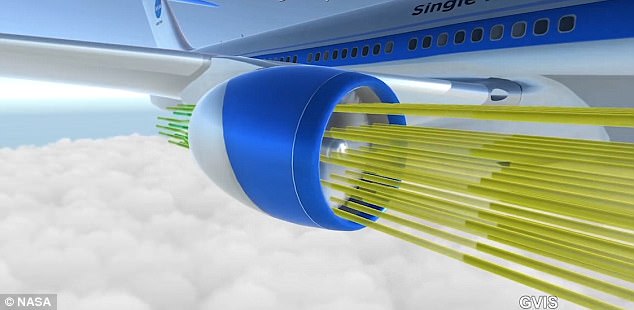
In a conventional aircraft air clings to the body of the plane but with this new design air is transformed into power. To drive the fan (pictured), two smaller engines provide thrust
In a conventional aircraft air clings to the body of the plane but with this new design air is transformed into power. To drive the fan (pictured), two smaller engines provide thrust to develop unique vehicle concepts that will use different fuselage shapes; longer, skinnier and more blended wings. 


Placing the Engine The BWB program is examining a new method for engine installation that promises to increase safety and fuel efficiency. Three advanced “high-bypass ratio” engines will be buried in the trailing edge of the outer section of the BWB wing, allowing the center of the craft free for flight deck use. While conventional aircraft engines only take in “free-stream air,” both the air on and near the surface of the wing will flow through the BWB’s curved inlets and into its engines. Taking in the layer of air on the wing surface reduces drag. While this technology will require validation before becoming a reality, researchers are initiating tests to determine acceptable levels of turbulence in the engine inlet

Turboelectric Distributed Propulsion Engine Cycle Analysis for Hybrid-Wing-Body Aircraft


Keywords: soviet fold wing ocean landing floating flying aircraft carrier with landing pad illustration render by concept artist alface killah artstation.com portfolio image samples boac


Comments

Popular posts from this blog

THE BATTLES OF THE PHILIPPINE AMERICAN WAR

    THE BATTLES OF THE PHILIPPINE AMERICAN WAR   Second Battle of Manila, Feb. 22-23, 1899 Section of Battery D, 6th US Artillery, on outpost duty near Fort San Antonio de Abad at Malate district, Manila, Feb. 21, 1899.   After pushing back the Filipino lines in the first battle of Manila and the suburbs on Feb. 4-10, 1899, Maj. Gen. Elwell S. Otis waited for more reinforcements from the United States. The San Francisco Call , issue of Feb. 22, 1899. Aguinaldo used the lull to reorganize and discuss plans for taking Manila. The districts of Tondo, Santa Cruz, and Malate were to be set on fire. Harper's Weekly ,  April 24, 1899 edition, drawn by G.W. Peters. Church in Santa Cruz district, Manila, late 1890's. The attack occurred on February 22. At around 8:00 p.m., fire broke out in the wealthy quarter of Santa Cruz district (during the 19th-century, the parian neighborhood of Santa Cruz commanded the highest in rental prices, com...
Design and Construction of Flying Aircraft Carriers with SWARMS of ‘Gremlin' drones My (BWB) blended wing body circular design will make it look like a flying saucer with hull and wing thickness of 25 inches or more making it indestructible in heavy seas, unlike the Russian design.  A pro totype was even tested in the 1950's, but today with computers and light materials of construction  we can build huge air ships more than 600' in diameter. Project 1794 is from the early 50's, by the United States Air Force and AVRO Aircraft. It used to be secret, but in 2012 the information has been declassified. I was really hyped when I found these two reports online at the National Archives, placed a link on my IFO site so that others could find it, but it didn't really get picked up. Kind of understand why: on the National Archives these pictures are not that easy to view, and they didn't color correct the scans. The video I made here is ...

KOREAN WAR 1950-1953: INTO THE FIRE

  KOREAN WAR 1950-1953   ( AP) The war that began in Korea 60 years ago, on June 25, 1950, a ghastly conflict that killed millions and left the peninsula in ruins, became “The Forgotten War” in many American minds. To a shrinking corps of aging men, however, the soldiers of Korea 1950-53, it can never be forgotten. It damaged many physically, scarred many mentally, and left men questioning their commanders’ and their nation’s wisdom. They fought many enemies – not just the North Koreans and Chinese, but also the heat, the killing cold and the cursed hills, the thirst, hunger and filth, the incompetence and hubris of their own army, and the indifference of an American homeland still fixed on the “good” war, World War II, that had ended five years earlier. In a wartime arc of desperation, triumph, retreat and final stalemate in Korea, no U.S. division sacrificed as much as the 2nd Infantry Division, losing more than 7,000 killed, one-fifth of total 36,516 U.S. dead...