


COULD THE USAF   USE  STARSHIP SPACE X FOR A FULL   ATTACK  AT CHINA

In 2021, the Air Force Research Laboratory kicked off its Rocket Cargo Program, which aims to use commercial rocket applications to rapidly deliver military cargo anywhere in the world in under an hour. This concept was considered so potentially significant that the Air Force itself quickly established the Rocket Cargo effort as one of just four Vanguard Programs — the branch's highest priority technological efforts. And while SpaceX's Starship may not be the only potential platform for the job, it may prove to be exactly what the Air Force and Space Force need to revolutionize military logistics.

US military eyes SpaceX Starship for 'sensitive and potentially dangerous missions': report
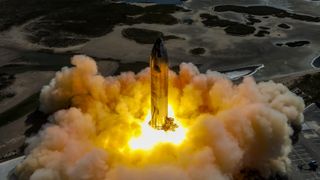


The Starship upper-stage prototype Ship 28 conducts a six-engine static fire test on Dec. 20, 2023. (Image credit: SpaceX)


The U.S. military is considering commandeering SpaceX's reusable Starship rocket for dangerous or sensitive missions.


The U.S. Department of Defense (DOD) has reached out to SpaceX to inquire about using Starship on its own, flying the massive rocket as a "government-owned, government-operated" asset on "sensitive and potentially dangerous missions," according to a recent report in Aviation Week.


Currently, the DOD contracts SpaceX as a launch services provider; in this new proposed arrangement the Pentagon would actually take control of the vehicle on its own.


PLAY SOUND


Aviation Week cites comments made on Tuesday (Jan. 30) by Gary Henry, a Senior Advisor for National Security Space Solutions at SpaceX, during the 2024 Space Mobility Conference held in Orlando, Florida.


"We have had conversations … and it really came down to specific missions, where it's a very specific and sometimes elevated risk or maybe a dangerous use case for the DOD where they’re asking themselves: 'Do we need to own it as a particular asset … SpaceX, can you accommodate that?'" Henry said at the conference.

"We've been exploring all kinds of options to kind of deal with those questions," Henry added.
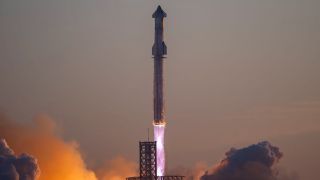


Starship launches on its second flight test on Nov. 18, 2023. (Image credit: SpaceX)

The DOD has been considering using Starship for years. As early as 2020, U.S. Transportation Command (USTRANSCOM) was discussing using the giant reusable rocket — which is not yet operational — for transporting cargo or even personnel rapidly around the world.

"Think about moving the equivalent of a C-17 payload anywhere on the globe in less than an hour. Think about that speed associated with the movement of transportation of cargo and people," former commander of USTRANSCOM Gen. Stephen Lyons said in Oct. 2020. "There is a lot of potential here, and I'm really excited about the team that's working with SpaceX on an opportunity, even perhaps, as early as '21, to be conducting a proof of principle."

Col. Eric Felt, director of space architecture for the Office of the Secretary of the Air Force for Space Acquisition and Integration, added that "there might be some use cases where there needs to be a government-owned, government-operated [vehicle], and that transfer can happen on the fly," Aviation Week reports.
RELATED STORIES:


SpaceX founder and CEO Elon Musk has even hinted at using Starship to send 1,000 human passengers on point-to-point flights around the world at hypersonic speeds held in place by amusement-park-like restraints. "Would feel similar to Space Mountain in a lot of ways, but you'd exit on another continent," Musk wrote on X in 2019.

Aside from potential U.S. military applications and its traditional usage as a commercial launch vehicle, Starship is being tapped for NASA's Artemis program. The agency plans to use Starship as a moon lander to ferry human crews to and from the lunar surface, beginning with the Artemis 3 mission no earlier than 2026.

A lot of development and testing has to go right before that can happen, though. SpaceX will first have to conduct a successful demonstration in which Starship will be used as an orbital refueling platform to top off a human lander after it uses most of its fuel after it leaves Earth and heads to the moon.

Starship is SpaceX's next-generation launch vehicle that the company hopes will help humanity build settlements on the moon and Mars. The massive rocket has flown on two test flights to date; one in April 2023 and again in November 2023. A third test flight could come as soon as February 2024, pending regulatory approval from the U.S. government.


Deployed to Okinawa, Japanese F-35 Fighters Take Up an Anti-China Mission

The U.S. Marine Corps’ F-35B—its version of a fighter being fielded by the Air Force and Navy—has vertical landing capabilities, but those may have compromised some aspects of the Lightning II’s performance.


Here's What You Need To Know: If Chinese ships and aircraft can isolate the Senkakus, then it will be easy for Chinese troops to occupy them. And very difficult to Japan to recapture them: the special amphibious brigade created by Japan would be a sitting duck. But even a few F-35Bs operating from rough airstrips—and perhaps armed with hypersonic anti-ship missiles—could disrupt a Chinese amphibious landing.


Japan may deploy its new F-35 stealth jet fighters to an airbase in southwestern Japan.

The location is not coincidental: Nyutabaru Air Base, in Miyazaki Prefecture, is situated nearer to Japanese islands and waters claimed by China.


“The envisioned deployment of the aircraft to Nyutabaru Air Base is aimed at keeping in check China’s maritime assertiveness around the area, including the Japanese-controlled Senkaku Islands in the East China Sea,” according to an article in the Japan Times. China claims the islands, which are located near China and Taiwan, as its own, and has repeatedly sent ships and aircraft into the area.


A former Japanese military officer recently made waves after saying he believes China plans to invade and annex Taiwan by 2025 and Okinawa by 2045.


The comments by retired Lt. Gen. Kunio Orita, a 35-year veteran of the Japan Air Self-Defense Force and a former commander of the 301st Tactical Fighter Squadron and 6th Air Wing, appeared last month in the English-language Taiwan News.

Orita, who retired in 2009 and is now a guest professor at Toyo Gakuen University in Tokyo, recently told Stars and Stripes he expects Beijing will attempt to expand its sphere of influence by first taking control of Taiwan and then militarizing a key disputed islet in the South China Sea.

Once that’s accomplished, he said, China will set its sights on Japan’s southern island prefecture, which hosts about half of the approximately 54,000 U.S. troops serving in Japan.

Beijing plans to force the United States out of Okinawa by fostering negative media coverage and supporting the anti-U.S. military protest movement on the island, the former general said.

“If China can push out the U.S. military from the region, it is possible that they can conquer the South China Sea and they will gain the power to stop any trade between Japan and other countries,” he said in a phone interview with Stars and Stripes on Jan. 28.

Shoal strategy The key to making this happen is building a naval port at Scarborough Shoal, an islet about 200 miles west of Manila in the South China Sea, Orita said. Beijing took control of Scarborough’s resource-rich lagoon from the Philippines in 2012.

“By building up their forces there, it will add tremendous pressure on surrounding countries,” he said, adding that China backed off plans to militarize Scarborough as it’s done on other South China Sea islets after U.S overflights of A-10 Thunderbolt IIs in April 2016.

A pair of B-52 bombers flew past the shoal in June, drawing condemnation from Beijing, according to The Associated Press.


This will begin with China declaring a no-fly zone around the island nation, he said, adding that any aircraft that tries to come to Taiwan’s aid will be shot down.

Orita then expects Beijing to provoke and attack Taiwanese navy and air force assets, both on land and in the Taiwan Strait, which separates it from China. Next, he expects them to blockade the island until Taiwan’s government agrees to come to the negotiating table, where a pro-Beijing regime will be installed.

“After taking over Taiwan, China will gain more influence over Indo-Pacific shipping lanes, then China can start to add nuclear pressure on the countries in the Pacific,” he said.


DEFENSE OF TAIWAN, ARCTIC AND NATO BY 82  MODIFIED 747 MISSILE CARRIERS: AVOID US NAVY SHIPS IN THE INITIAL ENGAGEMENTS: SPACE X ROCKETS CAN DELIVER MISSILES ACROSS THE PACIFIC FROM T HE WEST COAST IN LESS THAN AN HOUR ECONOMICLY


I like the theory, and what if they used the 747 platform as a mass anti-air AMRAAM platform, it would be a decent counter to Chinese numerical superiority. They could be guarded by a few F-16's/F-35s etc and the AWACS could guide them with a software update to target hostiles singularly. Stealthy cruise missiles fired from a large platform at a very safe distance actually represent a better chance of penetration than risking a stealth bomber flying directly into contested, hostile territory. Ground based radars in long wavelength may well make "stealth" bombers moot very quickly.  Stealthy cruise missiles fired from a large platform at a very safe distance actually represent a better chance of penetration than risking a stealth bomber flying directly into contested, hostile territory. Ground based radars in long wavelength may well make "stealth" bombers moot very quickly.

STATION ABOUT 30 CARGO BOMBERS LIKE BELOW IN JAPAN THAT COULD TAKE CARE OF THE DEFENSE OF TAIWAN SENKAKUS AND OKINAWA


The Airforce is doing this with palletized munitions on cargo aircraft. It allows them to turn C-130 and C-17s into missile trucks. A C-130 has a very low cost/flight hour and C-17 is comparable to a 747. And there are other platforms this could potentially work for, C-390 or A-400 for instance. This project doesn't require any modification of existing platforms. I wouldn't think the Airforce at this point would want to buy a legacy Aircraft for a suedo bomber conversion. But this was an interesting program.I visited the flight deck of a Cathay Pacific 747-400 on a flight from Paris to Hong Kong. It was a surprising experience to be flying over Russia, because the first time I went to Europe was before the USSR dissolved. I didn't get to see the landing from the flight deck, but watching the wingtip of the Jumbo skim the rooftops on approach into Kai Tak was something that I won't forget. Last year, I had a seat on the top deck of one of the last Qantas 747-400 flights from Haneda to Sydney. I did get to see Airforce One land in Canberra. I think it's the only one of those modified 747s ever to land in Australia.


Orita said China will then take the nearby Senkaku Islands, a disputed chain northeast of Taiwan and northwest of Japan’s Miyako island in the East China Sea also claimed by Japan and Taiwan, and encourage Okinawans to declare their independence from Japan.

The Chinese have long been antagonistic regarding the Senkakus.

In 2016, China sailed an aircraft carrier between Miyako and Okinawa’s main island. There have been frequent overflights of Chinese military aircraft in the same space since then, Japanese defense ministry officials told Stars and Stripes last year.

“China keeps pushing up the territorial line every year by breaking into Miyako-Okinawa,” Orita said.

The communist super power has also been “dumping money to influence Okinawa to turn its back on its country,” he said, in a reference to the island’s fervent anti-U.S. military movement.

Orita said he’s learned through intelligence sources that this includes funneling money to Okinawan media outlets for anti-U.S. military coverage. However, he could not provide proof of the assertion.

“China wants Okinawa to be an independent country,” he said. “An independent country does not need U.S. forces on the island.”

Dissenting opinions However, the retired general’s opinions are not universally accepted among Japanese academics. Aomori University professor Hideki Hirano told Stars and Stripes the comments were outlandish and questioned whether Orita had even said them.

Scholar, defense expert and former Japan Ground Self-Defense Force Lt. Gen. Toshiyuki Shikata said he agrees with Orita’s principles, but not his timeline.

“I don’t think Taiwan will be taken by military force by 2025,” he said. “China may use economic pressure as well as influencing the Taiwanese government and its people within instead.”

Shikata said he believes China would take Scarborough Shoal first and then move to take Taiwan, not the other way around.

“I believe China will expand its influence over Taiwan and Scarborough Shoal at the same time, as both are necessary for China to move toward the Senkakus,” he said.

However, if the Chinese do take Taiwan in the coming years, Shikata agreed that attempts to capture Okinawa are possible by 2045.

“China has been influencing Okinawa to become anti-U.S. military and anti-Tokyo,” he said. “China has been using the [protest] movement in Okinawa very well.”

Okinawan protest leaders have scoffed at assertions that their movement, which aims to reduce the island’s U.S. military footprint, has been co-opted by Beijing.

“If the Senkakus get taken over, the U.S. won’t be able to stop China,” Shikata said.

Neither Japan’s Defense Ministry nor Okinawan prefectural officials would comment on the former general’s statements.

A spokesman from the Office of the Secretary of Defense also would not comment specifically on Orita’s statements but said the Defense Department will “continue to pursue a constructive, results-oriented relationship with China.” It also will not accept policies or actions “that threaten to undermine the international rules-based order.”

“We will cooperate where our interests align, and compete, vigorously, where our interests diverge,” spokesman Marine Lt. Col. Christopher Logan wrote in an email to Stars and Stripes on Jan. 29.


“We have a vital interest in upholding the current rules-based international order, which features a free, prosperous, and democratic Taiwan. The objective of our defense engagement with Taiwan is to ensure that Taiwan remains secure, confident, free from coercion and able to engage in a peaceful, productive dialogue to resolve differences in a manner acceptable to people on both sides of the Taiwan Strait.”

Comments

Popular posts from this blog

THE BATTLES OF THE PHILIPPINE AMERICAN WAR

    THE BATTLES OF THE PHILIPPINE AMERICAN WAR   Second Battle of Manila, Feb. 22-23, 1899 Section of Battery D, 6th US Artillery, on outpost duty near Fort San Antonio de Abad at Malate district, Manila, Feb. 21, 1899.   After pushing back the Filipino lines in the first battle of Manila and the suburbs on Feb. 4-10, 1899, Maj. Gen. Elwell S. Otis waited for more reinforcements from the United States. The San Francisco Call , issue of Feb. 22, 1899. Aguinaldo used the lull to reorganize and discuss plans for taking Manila. The districts of Tondo, Santa Cruz, and Malate were to be set on fire. Harper's Weekly ,  April 24, 1899 edition, drawn by G.W. Peters. Church in Santa Cruz district, Manila, late 1890's. The attack occurred on February 22. At around 8:00 p.m., fire broke out in the wealthy quarter of Santa Cruz district (during the 19th-century, the parian neighborhood of Santa Cruz commanded the highest in rental prices, com...

KOREAN WAR 1950-1953: INTO THE FIRE

  KOREAN WAR 1950-1953   ( AP) The war that began in Korea 60 years ago, on June 25, 1950, a ghastly conflict that killed millions and left the peninsula in ruins, became “The Forgotten War” in many American minds. To a shrinking corps of aging men, however, the soldiers of Korea 1950-53, it can never be forgotten. It damaged many physically, scarred many mentally, and left men questioning their commanders’ and their nation’s wisdom. They fought many enemies – not just the North Koreans and Chinese, but also the heat, the killing cold and the cursed hills, the thirst, hunger and filth, the incompetence and hubris of their own army, and the indifference of an American homeland still fixed on the “good” war, World War II, that had ended five years earlier. In a wartime arc of desperation, triumph, retreat and final stalemate in Korea, no U.S. division sacrificed as much as the 2nd Infantry Division, losing more than 7,000 killed, one-fifth of total 36,516 U.S. dead...
UNDER GERMAN OCCUPATION AND THE FAMOUS TREE OF EUROPE Gnarled Polish tree that Jewish brothers hide inside to escape the Nazis is named best in Europe  Oak Józef, in village of Wiśniowa, south-eastern Poland, was used by two Jewish brothers to hide from Nazis  The Brimmon Oak in Wales, around which a new bypass will be built after a petition, finished as the runner up A Polish tree that two Jewish brothers used as a shelter for hiding from the Nazis during World War Two has been voted European Tree of the Year 2017. Oak Józef, in the village of Wiśniowa, south-eastern Poland, was also printed on Polish 100 złoty bills. Today it is admired by many visitors and is captured in many photos and paintings. The Brimmon Oak, in Newtown, in Wales, came runner-up in the competition. The competition started in 2011 as a way to highlight the significance of ancient trees. This year featured candidates from 16 countries and the participation of hundre...